
Why Uncertainty Around AI Is No Excuse for HR Leaders to Wait
Economist Jed Kolko points out that no one has yet worked out how to properly measure AI’s impact on employment. For HR leadership, that’s not a reason to sit tight; it’s a reason to rethink the approach.
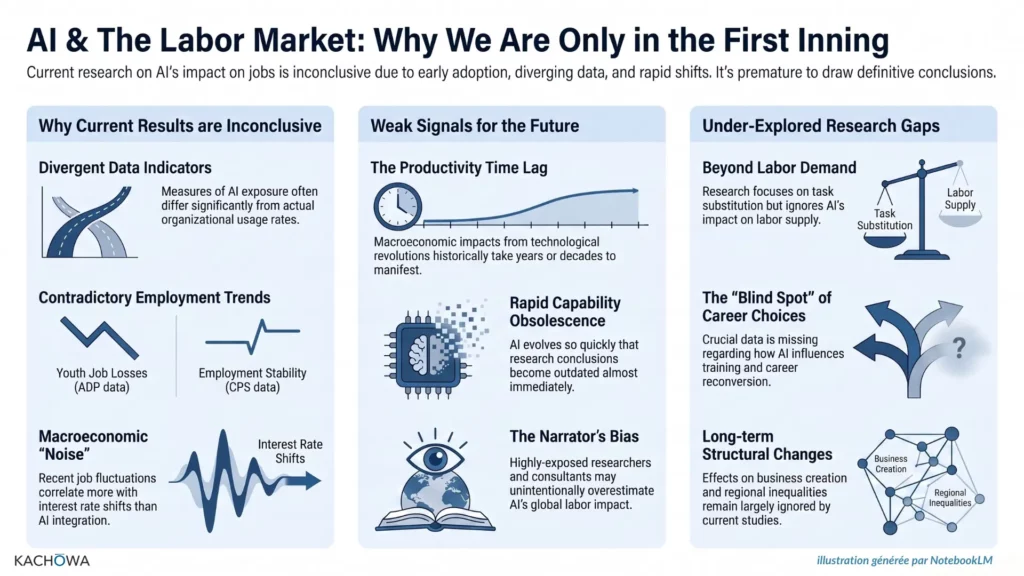
In a recent article for the PIIE, Jed Kolko makes an interesting observation: the wave of studies on AI’s impact on employment is still only in its “first round”. The data is too recent, the methods too immature, and exposure indices often contradict one another from one study to the next. His conclusion is simple: the big questions remain, for now, without a solid answer.
This is a useful reminder to treat the automation forecasts for 2030 doing the rounds with some caution—they’re often presented with far more confidence than the underlying data can support.
I’d like to take this a step further, to where economic analysis leaves off—because that’s exactly where HR leaders live day-to-day.
What Jed Kolko describes as scientific uncertainty, a business leader experiences as a decision that needs making right now. An HR director can’t afford to wait ten years for public statistics to settle. Decisions about human investment—who to recruit, who to train, which skills to anticipate—are made today, under uncertainty.
In his article, Kolko highlights two blind spots that strike me as particularly important:
First, research measures demand for labour but almost never supply. We model which tasks can be automated and which roles are exposed. What gets overlooked is how people actually respond. This is no small omission. On the ground, the mere anticipation of AI is already reshaping career paths: a professional who doubts the long-term future of their role adjusts their choices well before any technology is actually deployed. In some cases, human transformation happens ahead of technical transformation, not after it.
Second: standard taxonomies don’t capture the real pace of change in highly digitised sectors. In industries such as banking, AI integration is happening process by process, at a speed that annual statistics simply can’t keep up with. Waiting for aggregated data means making decisions with a lag of several years.
The upshot: if exposure indices are fuzzy and unstable, you can’t manage skills using fixed maps. The usual instinct—mapping out at-risk roles, projecting forward, and planning accordingly—rests on a stability that doesn’t actually exist.
Workforce planning needs to change in nature. Rather than forecasting a future state, the goal should be to pick up on weak internal signals and build transition dynamics capable of absorbing this uncertainty. It’s a shift from prediction towards adaptive anticipation. This is the logic behind the KACHŌWA approach to skills planning: predict less, and instead make the organisation genuinely able to adjust.
“Much of the recent research on AI and the labour market has focused on labour demand: that is, how AI will change the jobs, skills, or tasks employers will pay workers to do.”
And this only works on one condition, which ties back to Kolko’s first blind spot: treating the organisation and the individual as one system. A well-designed skills strategy fails if the people it affects remain frozen by fear or uncertainty. Conversely, individuals ready to move forward aren’t enough without organisational direction. The real capacity to execute a strategy sits exactly at that intersection.
What Jed Kolko says is right, and I think it deserves to be taken seriously: we lack hindsight, and no one should pretend otherwise. But on the ground, the absence of certainty doesn’t put decisions on hold. It simply changes how they need to be made.
The right question isn’t “When will we finally have the numbers?” It’s “How do we make sound decisions while we wait for them?”
Author

Houefa Gbaguidi
Founder of KACHŌWA. I help executives and HR leaders identify gaps between their strategy and their workforce capabilities, so they can make decisions with greater clarity.
Leave a Reply