
How AI is reshaping professions, and why this cannot be addressed through training
KEY POINTS TO REMEMBER
- Training staff in AI tools without addressing the issue of professional legitimacy results in compliance, not engagement. Adoption rates are rising, but the depth of engagement cannot be measured.
- Resistance to AI is not a cultural barrier to be overcome: it is an understandable professional reaction to a genuine restructuring of work. It concerns status, professional identity and perceived value within the organisation, not the tool itself.
- AI forces every professional to redefine what remains distinctly human in their role. This is a real, collective endeavour, and it takes time. Most organisations roll out the tool without creating the space for this conversation.
- Starting with the profession itself before discussing the tool changes the nature of the transformation. Once professionals have a clear understanding of what AI changes and what it does not change in terms of their added value, resistance can evolve into a constructive conversation about what the profession is becoming.
The issue of AI in the workplace has very quickly been reframed as a skills problem. When one reads reports on AI, studies by specialist consultancies and testimonies from HR departments, the conclusion is the same: we need to train, familiarise and support staff. Budgets are being channelled into these areas, and training programmes are multiplying.
This trend is not without foundation. Training makes sense: there is a gap between what professionals can do today and what they will be asked to do tomorrow with AI. But what we observe on the ground contradicts the idea that training alone is enough. Even fully trained teams continue to maintain a real distance from AI, not because of a lack of competence, but because something else is at stake.
The problem is not just a matter of skills. It is a problem that is harder to pinpoint, more uncomfortable to address, and one that existing systems are not designed to tackle.
This article offers a different perspective on what resistance to change in the face of AI implementation really signifies, why organisations avoid it, and what changes when we look at this resistance in a different light.
What AI training programmes overlook: three neglected dimensions
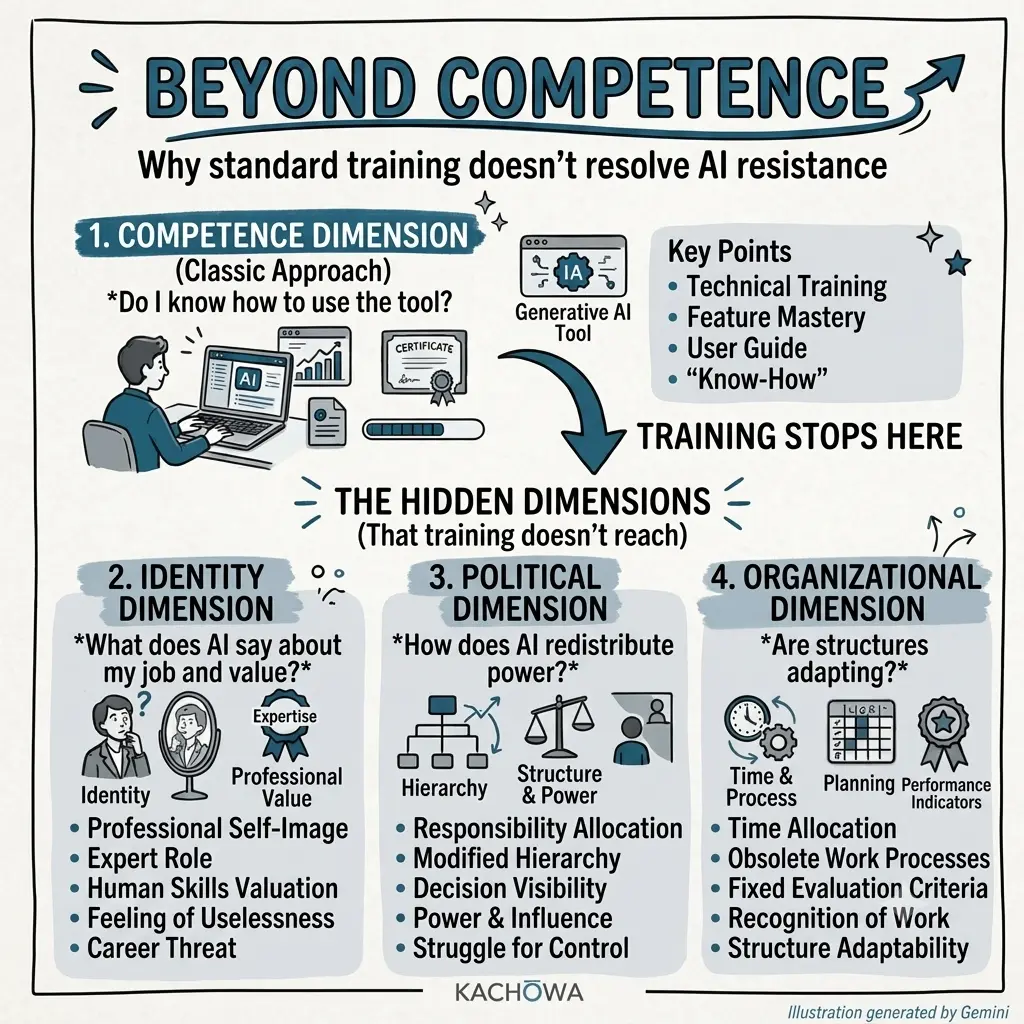
Faced with AI, organisations have been quick to come up with a response: training (skills development programmes, internal certifications, AI lead roles). The decision is made to tackle the visible problem – namely, the skills gap. But what is the underlying logic? If people haven’t integrated AI into their practices, it’s because they don’t yet know how to use it, haven’t been sufficiently exposed to it, or haven’t yet grasped all the benefits of this new tool.
This line of reasoning is coherent. It is actionable, measurable, fundable, and provides a clear course of action.
However, what we are seeing does not quite match this hypothesis. Despite training programmes, there remains some reluctance and unease about using AI:
- Professionals who are technically comfortable with the tools but maintain a real distance when using them.
- Trained teams whose commitment remains superficial.
- Comments that crop up discreetly: “This work done with AI isn’t really mine anymore”, “I’m not quite sure what I’m contributing anymore”.
These signs cannot be explained by a lack of training. They indicate that training addresses only one dimension of the problem: competence. It answers the question: “Do I know how to use the tool?”. But the resistance touches on other dimensions that standard approaches fail to address.
There is the identity dimension: what the use of AI says about the profession, about professional value, and about what justifies expertise. There is the political dimension: how AI redistributes responsibilities, visibility and power within the organisation. And the organisational dimension: time, processes, assessment criteria and recognition, which have often remained unchanged whilst the tools have evolved.
Until these three dimensions are addressed, we may end up with perfectly trained professionals who limit the use of AI to peripheral tasks, circumvent official tools, or adopt a posture of compliance without any real commitment.
What is really at stake: four mechanisms that go beyond competence
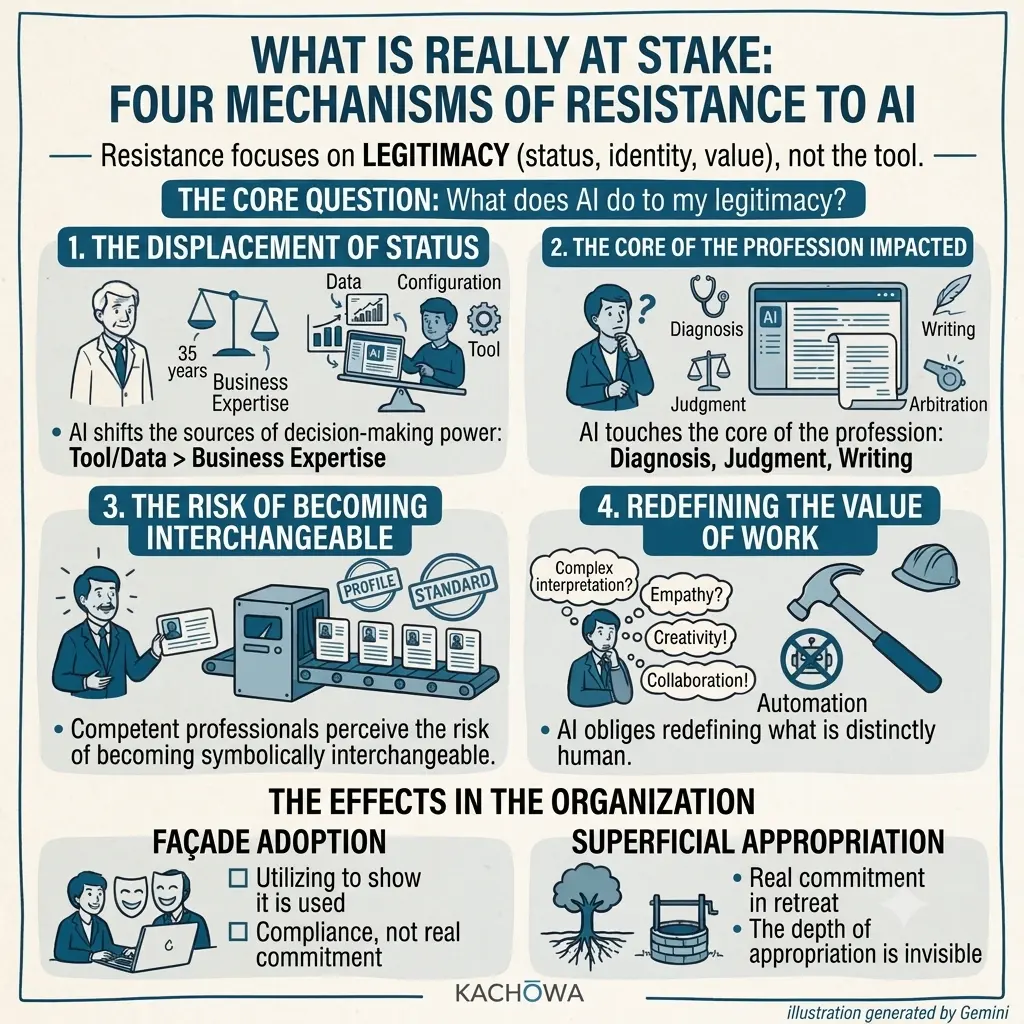
Resistance is not about the use of the tool as such. It concerns what the tool does to the professional’s legitimacy – that is, their status, their professional identity and their perceived value within the organisation. Four mechanisms recur, distinct yet linked by the same fundamental question: what does AI do to my legitimacy within this organisation?
1. The shift in status
AI is shifting the sources of decision-making power within the organisation. Where professional expertise once held sway, mastery of the tool, data or configuration is now taking centre stage.
For professionals whose influence was based on years of accumulated experience, this shift is very real: their opinions carry less weight in decision-making, whilst other stakeholders have gained visibility or influence.
This is not an irrational fear; it is a new interpretation of a genuine rebalancing of internal power dynamics.
2. The core of the profession is affected
When AI touches the very heart of the profession – that is, diagnosis, judgement, writing or even decision-making – resistance is no longer about the technology itself. It centres on what defines the profession itself. The question is no longer “does the tool work?” but “where does my added value still lie, and how do I make it visible?”.
A senior analyst at an insurance group, who has been accustomed to building her risk analyses from start to finish for twenty years. Since the roll-out of an AI tool in her team, the initial drafts are already arriving at her pre-written. She corrects them, refines them and signs off on them. Technically, she has a firm grasp of the tool. Yet she feels she is “validating rather than producing”. This shift, from author to proofreader, is not merely a matter of convenience. It touches on what, in her profession, she had always considered indispensable.
3. The risk of becoming interchangeable
Some technically skilled professionals resist because they perceive the risk of becoming interchangeable—not in technical terms, but symbolically. From their perspective, what AI does is standardise the very things that set them apart. Hence the anxiety: “If all it takes is validating what AI produces, then ultimately anyone could do this.”
Their expertise remains genuine, but what shifts is the social recognition it commands.
4. Redefining the value of one’s profession: real work, with no space to do it
AI forces every professional to redefine what remains distinctly human in their profession. That which cannot be automated, or at least should not be. This redefinition is real work. It takes time, it requires collective clarity, and it cannot be achieved alone.
Most organisations have not planned for this. They roll out the tool, provide training on how to use it, and measure adoption. But they do not create the space for this conversation. Professionals then find themselves resorting to a default response: preserving what they can, and limiting the exposure of anything that might be deemed replaceable.
The consequences of superficial adoption within the organisation
The effects are not confined to individuals. Adoption becomes superficial: the tool is used simply to show that it is being used. The most experienced professionals – whose judgement is precisely what AI cannot replace – go along with it without fully committing. They use it, they validate it, they tick the boxes. But their genuine commitment remains in the background, and this half-hearted compliance is difficult to detect.
Usage metrics are rising. The depth of adoption, however, cannot be measured.
Why organisations avoid this issue
Treating resistance as a training issue is more manageable. It is measurable, fundable, and organisable. Recognising the identity-related or political dimension of this resistance forces us to ask far more uncomfortable questions: does AI take away room for judgement and transfer it to algorithms or data teams? Does it devalue certain roles by making them more interchangeable? Is it designed as a complement or a substitute within the organisation’s actual economic trajectory?
These questions touch on strategy, internal power dynamics and the relative value of different roles. Standard frameworks are not designed to address them.
An analytical framework that oversimplifies what it is meant to illuminate
Traditional approaches to change management frame resistance as rational objections to be addressed through communication, as a lack of skills to be addressed through training, or as a lack of local support to be addressed through ambassadors.
They tend to interpret resistance as an individual problem (fears, habits, personal reluctance) rather than as an understandable professional reaction to a genuine restructuring of work.
Recognising that certain forms of resistance are legitimate means acknowledging that there are real losses: of status, of meaning, of autonomy. For many organisations, this is harder to accept than the prevailing narrative: AI as a neutral form of progress, resistance as cultural obstacles to be overcome, and the role of HR and transformation teams as facilitators of adoption.
This narrative is more comfortable, but it is not always accurate.
A poorly calibrated timeframe in relation to career paths
AI projects are managed with short-term horizons because speed is of the essence: pilot schemes lasting a few months, rapid return on investment, and phased roll-out. Redefining the relationship with the business is a slow process, involving debate, adjustments and collective bargaining. Deployment strategies are aligned with the project’s timeframe. They fail to take account of the timeframe of career paths.
Start with the business, before discussing the tool
AI integration: changing the starting point
There is another way to approach this issue. It does not start with the tool, but with the profession.
What is it, within this profession, that truly creates value? Which activities distinguish a competent professional from a recognised one? Among these activities, which remain distinctly human – not as a matter of principle, but because they require judgement, interpersonal relationships and a sense of responsibility that AI cannot fulfil?
These questions are not philosophical; they are strategic.
Returning to the profession’s true value chain
They require practical action: returning to the true value chain of each profession concerned, articulating what, within that profession, cannot be delegated to an algorithm, and collectively identifying, together with the teams and drawing on their experience, what continues to hold meaning and professional legitimacy once the tool has been integrated.
This work is not a preliminary step to deployment. It is a prerequisite for ensuring that deployment yields more than just superficial compliance. It does not take place in a training room. It is a long-term process, carried out with those who know the profession from the inside, based on the real issues at hand.
What changes for professionals when the role is clarified before the tool is introduced
When professionals have a settled answer to “this is what I do that has value, this is what AI helps me do better, and this is what it doesn’t change”, the nature of resistance changes. It doesn’t necessarily disappear; some tensions are real and deserve to be acknowledged. But it ceases to be a vague obstacle and becomes a constructive conversation about what the profession is evolving into.
Conclusion: the true measure of a transformation
Organisations leading these roll-outs know how to measure adoption. They can count active users, the hours of training completed, and the tools integrated into processes. What they measure less effectively is what lies behind these figures: the true quality of engagement, what professionals do with the tool when no one is watching, and what they have had to keep quiet about or work around in order to comply.
Resistance is not merely an obstacle to be overcome. It is a signal of what professionals are seeking to preserve in their work, of what the transformation actually costs, and of what standard metrics fail to capture. Ignoring this signal does not make it go away. It manifests itself in the quality of the work produced, in the commitment of the most experienced staff, and in the growing gap between what the organisation says it is doing and what it actually does.
Before seeking to convince professionals to adopt AI, perhaps there is a conversation to be had about what AI is reshaping in their profession. Not as a prerequisite that can be bypassed, but as a condition for what sustains it.
The question is not whether professionals will eventually adopt AI. Most will. The question is to what extent they will be committed to it, and what that ultimately says about the true quality of the transformation.
Sources
Wharton – 2025 AI Adoption Report: This report provides a comprehensive overview of generative AI adoption across organisations. It specifically highlights how companies measure usage patterns, expected gains and barriers to scaling AI initiatives. It’s an excellent resource for understanding how AI is currently framed in business settings—typically through the lens of performance, ROI and skills development.
The Conversation / article “When AI Undermines Professional Identity” (in French): This piece introduces the concept of professional identity threat in the context of generative AI. It demonstrates that resistance stems not simply from technical skills gaps, but rather from a deeper concern that the tool challenges the value of one’s profession, expertise or professional credibility.
Karsenty, “Change, Identity and Trust” (in French): This study reveals that when digital tools are introduced, the strongest resistance often comes not from usability challenges, but from perceived threats to professional identity. It highlights three critical effects: loss of control, erosion of established expertise, and weakened confidence in the change process itself.
Author

Houefa Gbaguidi
Founder of KACHŌWA. I help executives and HR leaders identify gaps between their strategy and their workforce capabilities, so they can make decisions with greater clarity.

Leave a Reply